Back to Texas

Texas confirms New World screwworm case; what Howe-area residents should know

State and federal officials confirmed New World screwworm in a South Texas calf, with guidance for Texans who own pets, livestock or other warm-blooded animals.

Maribel Sandoval

June 5, 20263 min read

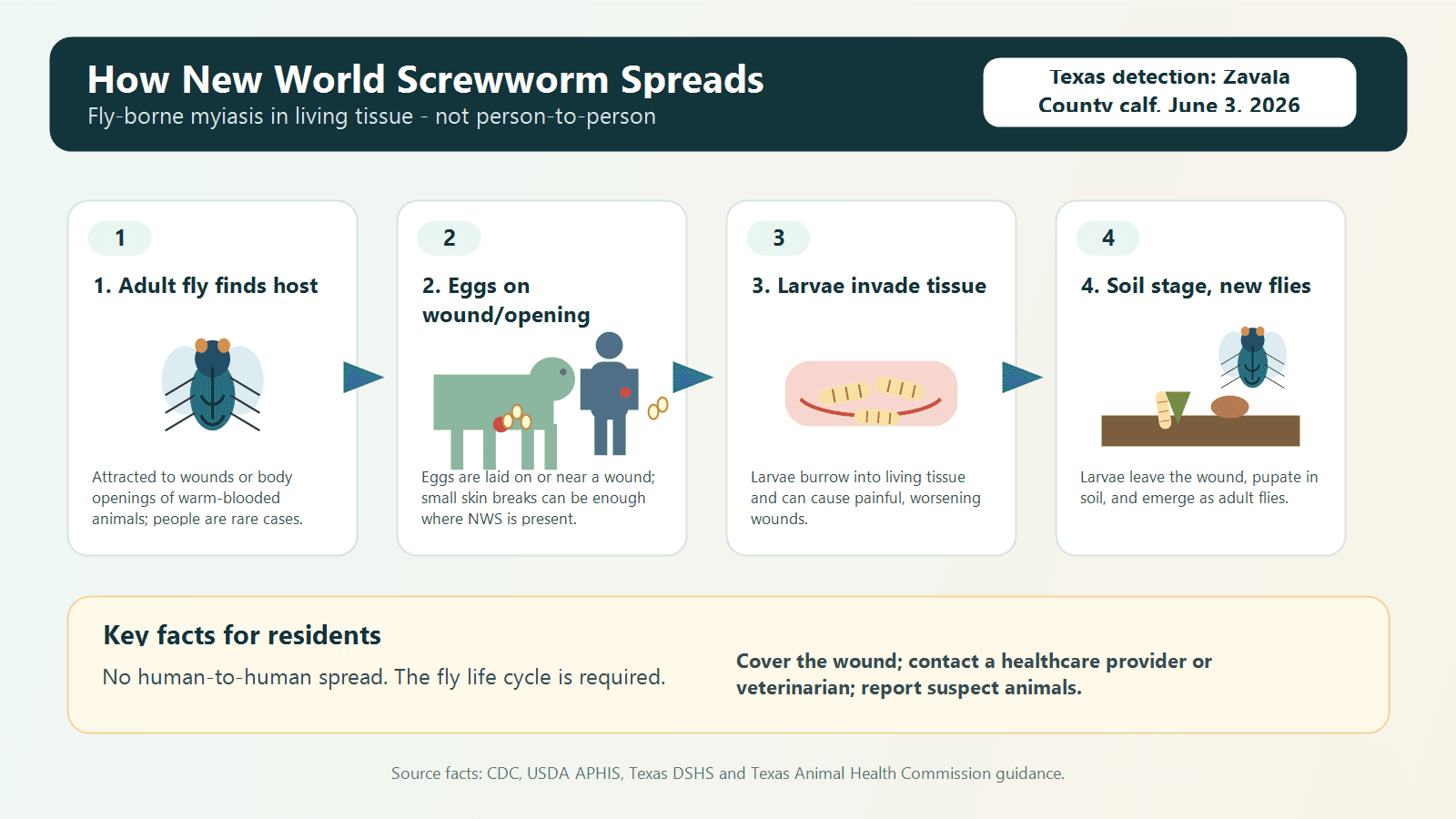
Medical-style illustration explaining how New World screwworm spreads from adult fly to eggs, larvae in tissue and soil pupation.

Texas and federal animal health officials have confirmed New World screwworm in a three-week-old calf in Zavala County, a South Texas case that matters statewide because the parasitic fly can affect livestock, pets, wildlife and, rarely, people.

The Texas Animal Health Commission said it received confirmation on June 3, 2026, after a sample from a calf with an umbilical lesion was identified as New World screwworm by the National Veterinary Services Laboratories in Ames, Iowa. TAHC said there were no further confirmed detections in animals in Texas at the time of its notice.

USDA's Animal and Plant Health Inspection Service also confirmed the detection in a bovine in Zavala County. Federal officials said the affected animal was a three-week-old calf and that larvae were identified in its umbilical area.

Why Howe should pay attention

The official notices reviewed did not report a Howe-area or North Texas detection. For Howe residents, the practical takeaway is awareness rather than alarm: anyone who cares for pets, livestock or other warm-blooded animals should know what the pest looks like, keep wounds clean and contact a veterinarian or health care provider quickly if larvae are found.

New World screwworm is a parasitic fly, not a worm. According to CDC and Texas DSHS guidance, female flies lay eggs on or near open wounds or body openings such as the eyes, ears, nose, mouth, genitals or the navel of newborn animals. When the eggs hatch, larvae burrow into living tissue and feed there.

DSHS says there is no human-to-human transmission of New World screwworm infestation. The infestation requires the fly life cycle, beginning with eggs laid by a female fly.

What people and animal owners should watch for

DSHS said people should seek immediate medical care if they notice a suspicious lesion or believe they may have contracted screwworm. The agency said providers should consider New World screwworm in patients who have traveled in areas with animal or human cases and who have a painful, foul-smelling wound containing visible larvae, or a deep wound with extensive tissue damage.

Anyone who sees or feels larvae in a wound should cover the wound and contact a health care provider immediately, according to DSHS. The agency warns people not to try to remove or dispose of eggs or larvae themselves because improper removal can cause further tissue damage and mishandled live larvae could create a risk of spread.

For animals, DSHS says signs can include irritation or discomfort, the smell of decay around a wound or body opening, open wounds or sores, and visible larvae. Pet and livestock owners who suspect an infestation should contact a veterinarian quickly. Livestock and pet cases should be reported to TAHC.


State and federal response

USDA said response steps include forming a unified Incident Command Team with TAHC, establishing a 20-kilometer infested zone around the detection, implementing quarantines and movement controls, increasing trapping, conducting wildlife surveillance and carrying out targeted local outreach. USDA also said officials are expediting targeted release of sterile New World screwworm flies, a technique intended to reduce reproduction.

TAHC's executive director order applies to an Infested Zone 01 in parts of Uvalde and Zavala counties. Warm-blooded animals in that zone may not be moved outside the zone without prior authorization from TAHC, and movement requires inspection, required treatment and a permit or certificate.

DSHS and USDA both said the food supply is safe. USDA said screwworms do not infest meat, fruits, vegetables or other food sources, and DSHS said state and federal meat inspectors examine animals for signs of disease or pests, including screwworm.

Sources

Texas Animal Health Commission, New World Screwworm Confirmed in Zavala County Calf, June 3, 2026: https://www.tahc.texas.gov/news/2026/2026-06-03_NWS_InitialCase.pdf

USDA APHIS, USDA Confirms Presence of New World Screwworm in the United States, June 3, 2026: https://www.aphis.usda.gov/news/agency-announcements/usda-confirms-presence-new-world-screwworm-united-states

Texas DSHS, DSHS provides precautions following animal New World screwworm case in Texas, June 4, 2026: https://www.dshs.texas.gov/news-alerts/dshs-provides-precautions-following-animal-new-world-screwworm-case-texas

Texas DSHS, New World Screwworm (NWS): https://www.dshs.texas.gov/notifiable-conditions/zoonosis-control/zoonosis-control-diseases-and-conditions/new-world-screwworm

CDC, About New World Screwworm, February 24, 2026: https://www.cdc.gov/new-world-screwworm/about/index.html

CDC, Clinical Overview of New World Screwworm, February 24, 2026: https://www.cdc.gov/new-world-screwworm/hcp/clinical-overview/index.html

Texas Animal Health Commission, Executive Director Order Declaring Animal Movement Restrictions due to New World Screwworm in Uvalde and Zavala Counties, June 3, 2026: https://www.tahc.texas.gov/regs/pdf/2026-06-3-NWS-Zone01.pdf

Share

Maribel Sandoval

Maribel Sandoval writes about community events, churches, and local life in Howe.

Related Stories

Texas

Texas Broadband Grant Rules Draw Senate Scrutiny

A Texas Senate committee hearing put new scrutiny on broadband grant rules after lawmakers questioned whether recent changes give satellite internet providers different treatment from traditional rural broadband companies.

Bree TanakaJuly 3, 20261 min read

More in Sport